
Orwell’s 1984 Should Have been 2025
George Orwell Did Not Take Into Account 41 Years of Tory Government
Introduction
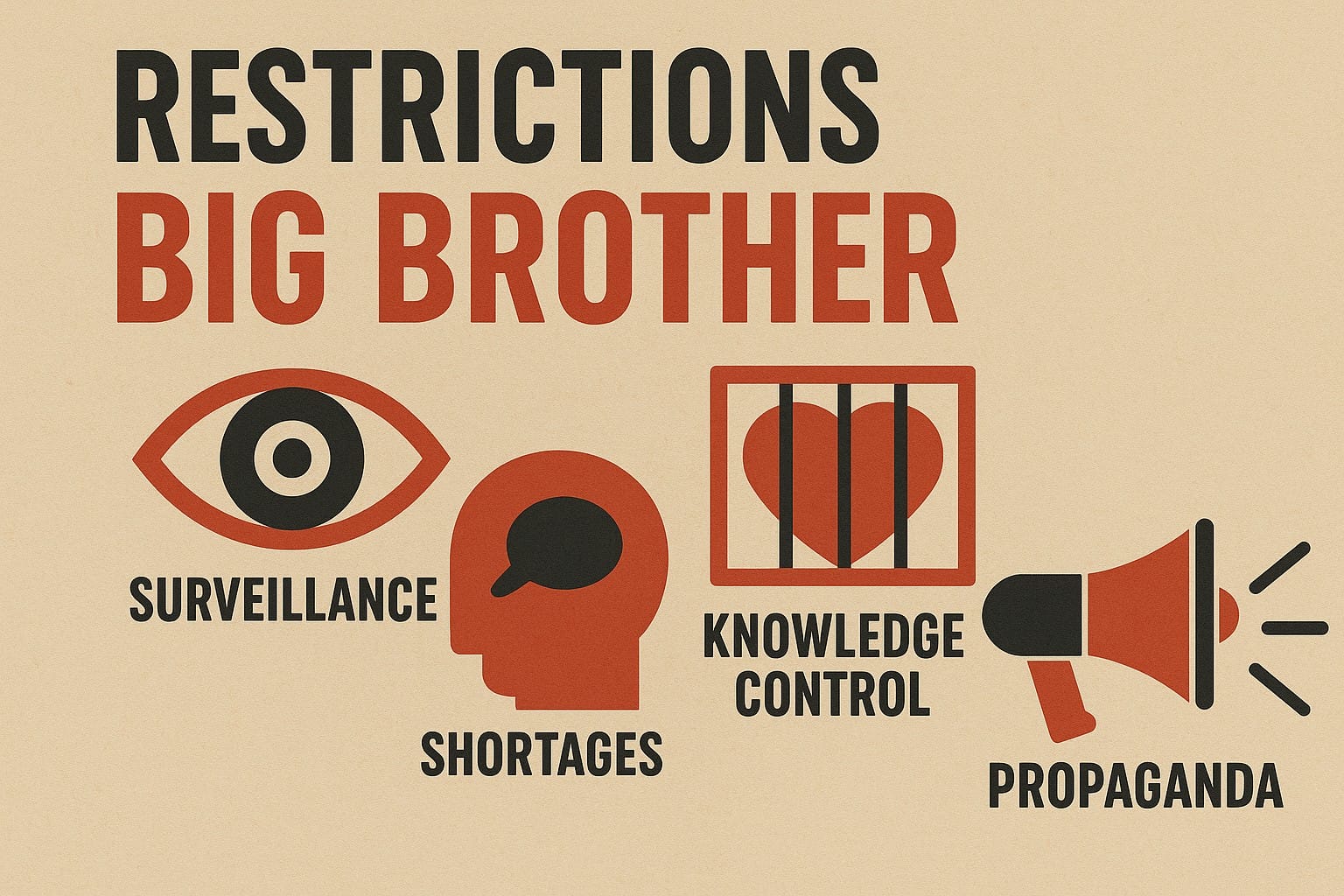
George Orwell’s Nineteen Eighty-Four, published in 1949, remains one of the most powerful dystopian novels of the 20th century. It imagines a totalitarian future, set in 1984, in which the state exerts absolute control over truth, history, language, thought, and private life. The novel’s themes of surveillance, propaganda, rewriting history and thought control resonate with 2025.
The reason many believe George Orwell named his book 1984 is that he thought it would take 100 years before Fabianism (the doctrine of the Fabian Society) would come into effect. The Fabian Society was founded in 1884 and advocated a gradual, reform-based transition to socialism. Past and present members of the Fabian Society include Keir Starmer, Angela Rayner, Tony Blair, Clement Attlee, Harold Wilson, and many current and former Labour members of parliament.
George Orwell did not know that there would be 41 years of Conservative government after he died in 1950, when Clement Attlee was still Prime Minister. Forty-one years after 1984 brings us to 2025, where many of the predictions in George Orwell’s book are fast coming true in one form or another.
Orwell’s Predictions
Orwell predicted a bleak superstate called Oceania, ruled by the Party, with ubiquitous surveillance, the manipulation of facts, the invention of Newspeak to restrict thought and free speech, and the crushing of individuality.
Some of the central predictions in Orwell’s book included:
- Surveillance and control: the slogan “Big Brother is watching you” embodies the idea of a state that monitors not only physical actions but thoughts (thought-crime).
- Manipulation of truth and history: the past is constantly rewritten to align with the Party’s current line. That undermines objective reality.
- Language as power: With the invention of Newspeak, the Party seeks to limit what people can say and think, thus reducing the words available to express dissent.
- Class structure and hopelessness of rebellion: Winston Smith (the protagonist) belongs to the Outer Party, which is largely ignored, with rebellion being almost impossible.
- Totalitarianism as cautionary vision: Orwell aimed to warn of authoritarian futures, and while his book is fictional, the predictions are not that far from the truth.
Orwell himself described the novel as a warning of what could happen if intellectual and political freedoms are lost, rather than as a precise prophecy.
Predictions Coming True
Many of Orwell’s predictions seem relevant today in the UK under the Starmer regime, as follows:
Surveillance and Data Collection
- Modern societies deploy extensive digital surveillance: CCTV, smartphone tracking, social media analytics, metadata gathering, and facial recognition.
- While no society (in democratic countries) has the omnipresent Party of 1984 yet, critics argue we are creeping toward “panopticon” conditions where behaviour can be monitored and influenced.
- The manipulation of personal data, targeted advertising, and algorithmic shaping of what we see and think: these are echoes of the novel’s themes of information control.
Manipulation of Information and Truth
- The rewriting or selective presentation of history, fake news, spin, and echo-chamber effects all resonate with Orwell’s warnings about the control of the past and of language.
- The phrase “post-truth” has become common. The idea that objective facts could become contested, or that parties and powers might reinterpret history to suit present aims, is very much alive.
Language and Political Discourse
- The concept of “Newspeak” (reduction of language to limit dissent) is mirrored in discussions about euphemistic or manipulative political language (“alternative facts,” “weaponised language,” etc.).
- The shrinking of public discourse, or the sense that certain views become unmentionable, is sometimes compared to the novel’s mechanisms.
Political Structures and Class
- While the novel’s rigid party structure is not exactly present in modern democracies, one might argue that there are increasing concerns about elite power, technocratic governance, and peripheral disenfranchisement.
- Moreover, the sense of alienation, economic precarity, and disempowerment of large groups echo the “proles” (i.e. members of the working class) in Orwell’s novel, though without the same institutional framework.
Are We There Yet?
There is no Party with absolute control of thought in the style of 1984. Many societies still have a free press, an independent judiciary, and civil rights, but the warnings feel closer than when Orwell wrote his book. Orwell’s dystopia remains a warning rather than a prediction of what will happen, but many of its features are appearing in varied, partial forms in the 21st century.
Nineteen Eighty-Four is a compelling work because it dramatises what can happen when power is unchecked, when truth is subordinated to ideology, when language becomes a tool of control. While the concrete vision of the novel (an all-encompassing Party, constant war, total suppression of individual thought) has not manifested fully, the tendencies Orwell described are alive in our era.
The connection to the Fabian Society adds an intriguing dimension, especially if Orwell chose 1984 partly to reference the centenary of its 1884 founding. In that case, he may have been suggesting that a hundred years of institutional and social change could yield a profoundly transformed society. In 2025, we stand past that hundred-year mark, having had 41 years of Conservative government whose members did not follow the Fabian Society's doctrines. While we have not yet arrived at Orwell’s darkest vision, we are arguably closer than ever to some of its mechanisms.
Ultimately, the message remains. The world of Nineteen Eighty-Four is not inevitable, but the choices we make about power, language, truth and individual freedom determine how far we drift toward it.