
The Fabian Society Aims and Progress
Introduction
The Fabian Society was founded in January 1884 in London. It took its name from the Roman general Quintus Fabius Maximus, renowned for his strategy of patience and gradualism rather than direct confrontation. This symbolism reflected the Society’s guiding philosophy: the pursuit of socialism through steady, incremental reform instead of violent revolution. From its earliest days, the Fabian Society sought to reshape British society by working within existing democratic institutions.
Objectives of the Fabian Society
The Fabian Society’s central aim has always been to promote democratic socialism. Fabians believed in creating a fairer, more equal society, but rejected revolutionary methods, favouring reform through Parliament, public debate, and policy development. Their vision included wide-ranging social reforms such as minimum wages, universal healthcare, free education, and welfare provision for the poor.
Another key objective was intellectual influence. The Society produced pamphlets, organised lectures, and hosted debates to spread socialist ideas among educated middle-class audiences and political elites. This approach was known as “permeation”, which is influencing established political parties initially the Liberals and later the Labour Party by embedding socialist ideas within mainstream politics rather than forming a radical opposition outside it.
George Orwell and the Fabian Society
A commonly discussed theory suggests that George Orwell titled his novel 1984 to reflect the centenary of the Fabian Society’s founding in 1884. According to this interpretation, Orwell believed it might take a hundred years for Fabian ideas to materialise fully. While Orwell was not a Fabian himself, he was deeply engaged with socialist thought and critical of how power could be abused within collectivist systems.
Orwell died in 1950, when Clement Attlee was still Prime Minister. Orwell could not have foreseen the long periods of Conservative government that followed. Forty-one years after 1984 brings us to 2025, a time when some readers argue that elements of Orwell’s warnings, such as surveillance, state influence, and information control, appear in subtle and varied forms.
Past and present members of the Fabian Society include prominent Labour figures such as Clement Attlee, Harold Wilson, Tony Blair, Keir Starmer, and Angela Rayner, as well as many other current and former Labour Members of Parliament.
Impact of the Fabian Society
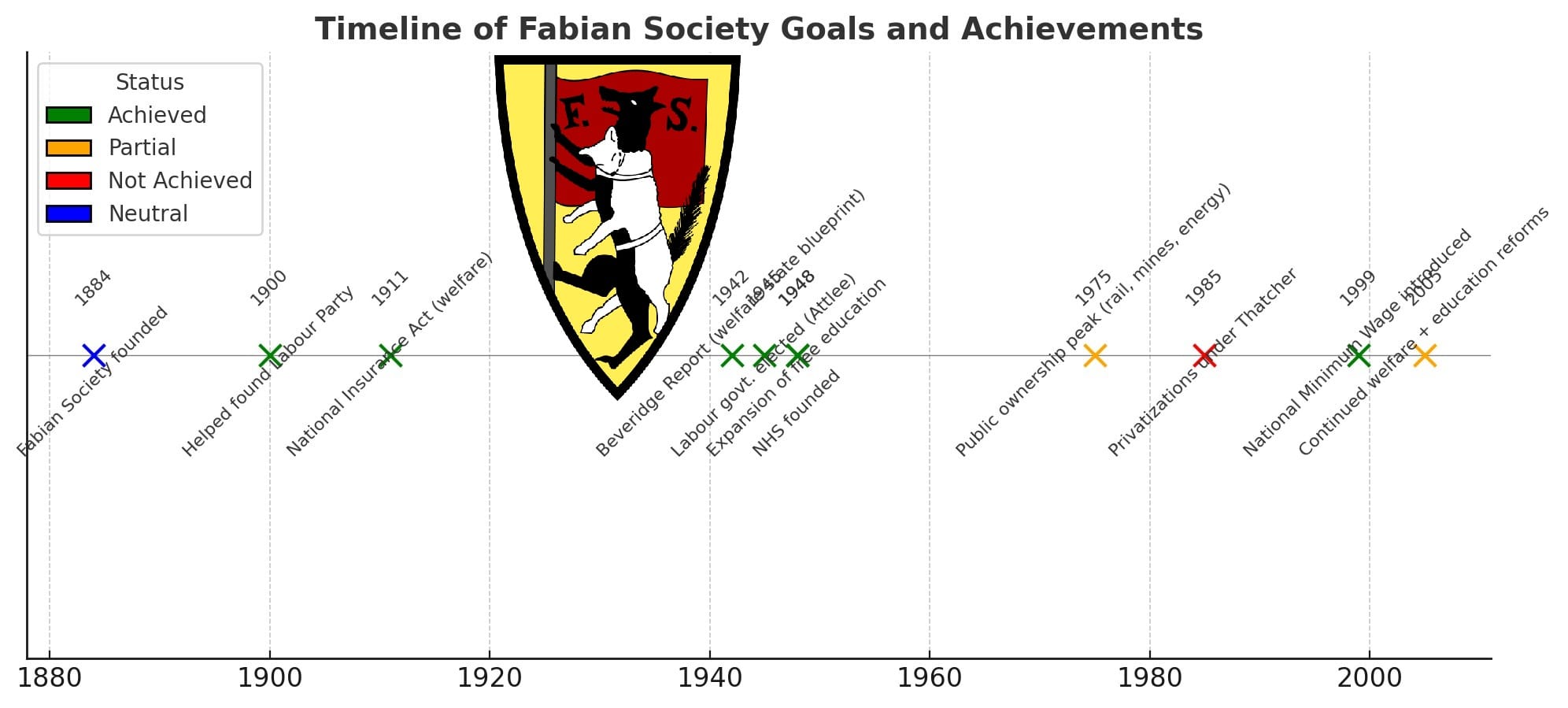
The Fabian Society played a crucial role in the founding of the Labour Party in 1900. Influential members such as Sidney and Beatrice Webb, George Bernard Shaw, and H.G. Wells helped shape the intellectual foundations of British social democracy. Over time, Fabian ideas became embedded in many of Britain’s core institutions.
One of the most significant achievements influenced by Fabian thinking was the welfare state. Early reforms, such as National Insurance in 1911, were followed by the Beveridge Report in 1942, which laid the groundwork for comprehensive welfare provision. Support for unemployment, sickness, and old age became standard features of British society.
The creation of the National Health Service in 1948 under Clement Attlee’s Labour government marked another major Fabian success. Free healthcare at the point of use had long been a core Fabian objective and remains one of the most enduring symbols of their influence.
Education reform was also central to the Fabian vision. The expansion of free, compulsory schooling, later followed by free secondary education and broader access to universities, reflected their belief that education was essential for equality and social mobility.
Achievements and Limitations
Many Fabian goals have been wholly or largely achieved. Workers’ rights were strengthened through measures such as the introduction of the minimum wage in 1999, improved workplace safety, paid holidays, and union protections. Progressive taxation became a norm, redistributing wealth to fund public services. Fabian influence has also remained strong within the Labour Party, shaping its policies across generations.
Other goals have been only partially realised. While there has been significant progress toward equality of opportunity through welfare, healthcare, and housing reforms, wealth inequality remains high. Public ownership expanded dramatically after 1945, with industries such as railways, mines, and utilities nationalised, but many of these were later privatised from the 1980s onwards.
Some ambitions remain largely unrealised. Britain continues to operate as a capitalist economy, and the Fabian vision of full economic equality has not been achieved. Permanent public control of major industries has also proven temporary rather than enduring.
Conclusion
Since its founding in 1884, the Fabian Society has profoundly shaped British political and social life. Through its commitment to gradualism and democratic reform, it helped create the welfare state, the NHS, expand education, and strengthen workers’ rights. While its vision of an entirely equal socialist society remains incomplete, Fabianism has succeeded in embedding reformist socialism into the fabric of modern Britain, arguably achieving more through patience and persuasion than revolution ever could.