
The Issues with Cosmological Red Shift Interpretation by Hubble and the Speed of Light
Einstein and Dicke have shown that the speed of light varies with gravity, which in turn causes light to redshift. This raises questions about the size and age of the observable universe. If the cosmological redshift observed by Hubble is solely due to the variable speed of light, then we do not have an expanding Universe, and all our distance measurements are wrong. This article discusses these issues.
Introduction
Towards the end of 2023, I was watching Dr Becky Smethurst’s YouTube channel explaining that the Crisis in Cosmology had got worse as the James Webb Space Telescope (JWST) had provided better data on types of stars, called Cepheid variables. The Crisis in Cosmology (also called the Hubble Tension) has arisen because the expansion and age of the Universe, as calculated from the Cosmic Microwave Background (CMB), conflict with measurements of Cepheid variable stars' velocities and distances, which are increasingly divergent.
One of the few reasons Dr Becky gave for this crisis is that there could be something wrong with our best model of the Universe, which got me thinking about why the two measurement methods do not agree. I thought about this for a day and concluded that the speed of light from Cepheid variable stars was slower because of variations in the gravitational field. This seemed a wild idea to me, as the speed of light is supposed to be constant for all observers. Consequently, I sent an email to Dr Becky explaining my thoughts, but I did not receive a response, and then I thought no more about the issue. I did not realise at the time that my suggestion of a variable speed of light as the solution was sacrilege and went BLE against the Big Bang theory, even though the greatest minds of the twentieth century, Einstein and Robert Dicke, had both written papers supporting this idea.
Variable Speed of Light Articles and Calculations
It is quite fortunate that in early 2024, I stumbled across Alexander Unzicker’s Real Physics YouTube channel, where I learnt more about the topic of the variable speed of light. Einstein had referred to the variable speed of light many times in various papers before the publication of Special Relativity in 1905. In 1911, he published a paper, “On the Influence of Gravitation on the Propagation of Light (ref 1), which states that the speed of light is constant where there are no other gravitational effects present. If there is a gravitational effect, there is a reduction in the speed of light caused by the gravitational effect of nearby bodies. Einstein specified a formula to calculate the gravitational effect.
The reduction of the speed of light is given by the following Einstein formula (the calculation is carried out for Earth):

Reference: (1)
Where Φ is the Gravitational Potential for Earth
c is the speed of light
c0 is the speed of light as measured on Earth
Φ = 60 MJ/kg for Earth
After a calculation, the free-space speed of light, with no gravitational effects present, is 299,792,458.2 m/s, based on the agreed-upon two-way calculated reflected speed of light measurement carried out on Earth. The impact of the gravitational reduction in the speed of light causes the speed of light, c, to decrease. Since c = λf (where λ is the wavelength of light and f is its frequency), this results in a red shift in wavelength and a change in frequency.
The value of Φ for the Milky Way galaxy (and similar galaxies) is 4 x 10¹¹ J/kg, so the speed of light originating from the Milky Way galaxy would be 299,792,124 m/s, which would also cause red shift.
The cumulative effect of light from the edge of the observable Universe arriving at Earth will be redshifted by gravitational effects as it passes through many galaxies (see diagram below). This does not account for any redshift caused by the expanding Universe (if it is indeed expanding). Consequently, any Hubble Doppler distance calculations will be widely off, and the results will assume that the edge of the observable Universe is further away than it really is.
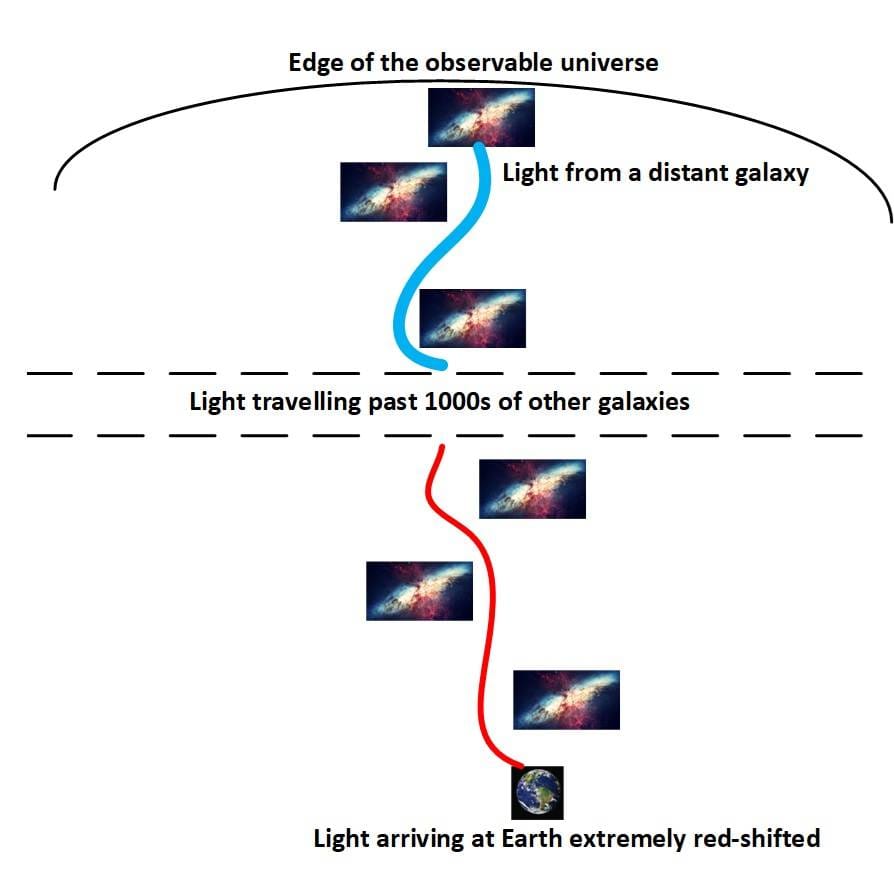
The Cumulative Effect of Light Travelling Past Many Galaxies is Shown Above
Although the Einstein paper of 1911 is significant, it was largely ignored because it was published just before the outbreak of World War 1. Robert Dicke, unaware of Einstein’s 1911 paper, authored a 1957 paper (ref. 2) proposing an alternative explanation [to Hubble] of cosmological redshift that supported Einstein's 1911 findings.
Fritz Zwicky, in 1929, authored a paper (ref 3) and concluded that for thermodynamic reasons if light is traveling through a system of masses with very high average velocities there will be gravitational drag exerted on light (the effect being termed “tired light”) and consequently the observed red shift of light could be solely, or partly, because of this effect.
In 2023, theoretical physicist Rajendra Gupta, from the University of Ottawa in Canada, published a rather extraordinary proposal (ref 4) that the Universe's currently accepted age is a trick of the light, one that masks its truly ancient state while also ridding us of the need to explain hidden forces and concluded that the Universe has no Dark Matter and Is 26.7 billion years old. Gupta's hypothesis, based on what is referred to as covarying coupling constants plus Fritz Zwicky’s tired light (CCC+TL), suggests that this would affect the Universe's expansion and eliminate the need to invent Dark Matter in 1933 to explain the motion of galaxies. Several other cosmologists and scientists have expressed alternatives to the current cosmological theory, although most of their papers have been ignored.
Mainstream cosmologists stick to the premise that the speed of light is fixed throughout the Universe. I have watched many YouTube physicists state that their papers could not be published because leading journals rejected them for topics related to the variable speed of light or a different cosmological model. There are also a few YouTube presentations (ref. 5) that discuss other situations in which redshift occurs, unrelated to the standard redshift (Doppler effect caused by distance).
This “don’t confuse me with the facts, my mind’s made up” attitude seems to be present in online Physics forums as well. I responded to a question on Dark Matter in the Reddit forum “AskPhysics” with a few paragraphs of information regarding Einstein’s 1911 paper and the redshift it causes, as well as the possibility that Dark Matter may not exist. The response was “You have been permanently banned from participating in AskPhysics because your comment violates the community’s rules.” Obviously, the rules must be that you have to toe the line and agree with the current Big Bang model, as well as Dark Matter and Dark Energy. Not that they are, or ever were, members of this forum, but Einstein, Zwicky, Gupta, and Unzicker (who has a YouTube channel outlining similar concepts) would also be banned.
This attitude is also prevalent among mainstream archaeologists, who maintain that the first civilisation on Earth occurred 5500 years ago in Mesopotamia (3500 to 500 BCE), followed by the Egyptian civilisation (3150 to 30 BCE). They largely ignore evidence of much older civilisations dating back 14,200 years.
The Origin of the Universe
The Universe is evolving; the Andromeda galaxy and the Milky Way are moving closer together, while other galaxies are either moving towards or moving away from each other. Stars are going supernova and being formed, so the Universe is not in a stable state but is ever-evolving.
In 1929, based on his previous discoveries of a relationship between a galaxy's distance from Earth and its velocity, Edwin Hubble claimed that most of the Universe was expanding and moving away from everything else. If that is the case, then logically, if we rewind the universe, it would have started from a single point (a singularity). Hence, something must have initiated the universe's expansion (the so-called Big Bang). Georges Lemaître, a Belgian cosmologist and Catholic priest, put this idea in scientific form in 1931. He is often referred to as the father of the Big Bang. Einstein did not believe in the Big Bang theory (ref 5), but he eventually changed his mind eighteen years later in 1932, after a visit from Hubble.
The three main reasons Hubble stated as evidence of the expansion were the cosmological redshift of light from galaxies, the measured abundances of elements in the Universe, and the observed expansion of space.
In 1948, Fred Hoyle, Herman Bondi, and Thomas Gold proposed that the Universe had no beginning or end and exists in a steady state. As the Universe evolves, new stars and galaxies continuously replace the old and unobservable ones. The steady-state theory was supposedly disproved by observations showing that the density of faint radio sources is higher than that of strong ones, implying that there were more cosmic radio sources billions of years ago than there are at present. Another fact is based on the discovery of CMB radiation, which many believe reveals the state of the Universe 380,000 years after the Big Bang.
Assuming Hubble was correct, the most distant objects astronomers can see are around 46.5 billion light-years away. It is possible that the whole Universe (including the unobservable part) is at least twenty-three trillion light-years in diameter and contains a volume of space that is over fifteen million times as large as the observable Universe. It is estimated that the Universe could contain up to one septillion stars (that is, a one followed by 24 zeros) and 2 trillion planets.
The Big Bang theory posits that the universe originated from a single, unimaginably hot and dense point, known as a singularity, where all matter is compressed. Other singularities exist at the centre of Black Holes, and the smallest Black Holes may cram as much matter as three million Earths into a single tiny point, whereas some Black Holes, called supermassive Black Holes, may have as much matter as one thousand million stars. The more matter Black Holes devour, the bigger and heavier they get. So, it seems pretty likely that there was a gigamassive Black Hole (millions of times bigger than a supermassive Black Hole) that contained all the matter in the known Universe. This Black Hole exploded (the Big Bang!), and that is how the Universe started. It may even be that there are (or still are) many gigamassive Black Holes beyond the boundary of our current Universe, and that some galaxies in our own Universe are the result of another Big Bang from beyond that boundary.
Many mathematicians, cosmologists, astrophysicists, and scientists back the current Big Bang theory. The primary evidence for this is the cosmological redshift, which can indicate the distance to objects and their expansion rate. Einstein, Dicke, and others have demonstrated that light is affected by gravity, causing its wavelength to shift toward the red end of the spectrum. This means that the speed of light as observed on Earth is one value, and the speed of light as observed on (say) Jupiter is another. This has many implications, as we do not know the speed of light for sure in the absence of a gravitational effect upon it. The calculation of this using Einstein’s formula, previously shown, is only a rough estimate, as we do not have a definite speed of light as measured on Earth. The figure 299,792,458 m/s is the current agreed-upon standard, but it may vary slightly or differ slightly in one direction because the speed measurement is based on a two-way round-trip. In addition, there are different ways light can be redshifted, and these are explained in the YouTube video, “5 Alternative Explanations for the Redshift we Observe (ref 6).
Mainstream cosmologists do not and will not listen to any alternatives to the current Big Bang model of the Universe, even though the JWST is finding evidence that the physics needs to be changed. JWST has observed enormous galaxies, such as the Maisie Galaxy, which, according to cosmological redshift, formed 390 million years after the Big Bang. This galaxy, along with 15 or so other galaxies that should not exist, challenges the current Big Bang model. Consequently, many cosmologists agree that the current model needs updating. Suppose we use the reduced speed of light when calculating the gravitational tensor for galaxies (based on the Einstein formula). In that case, we find that the gravitational tensor is much bigger than initially estimated. Einstein’s simplified gravitational tensor field equation, showing how objects affect the warping of spacetime, is as follows:
Guv = 8 π G / c4 (the second G is the gravitational constant) (2)
Bearing in mind that c in this equation is the speed of light caused by the gravitational effect of a galaxy, given by formula (1) above, the value of Guv can double or triple depending on the local speed of light. In fact, this may negate the need to invent Dark Matter and Dark Energy to account for the gravitational deficiency that cosmologists and astrophysicists claim is missing in the Universe. So, no more do we need this hypothetical form of matter that appears not to interact with light or the electromagnetic field, and the statement that “Dark Matter is implied by gravitational effects which cannot be explained by general relativity unless more matter is present than can be seen” is not correct once Einstein’s addendum to the speed of light is taken into account. Alternatively, Gupta may prove to be accurate, although “tired light” may need to be re-classified as “variable speed of light.”
If the Universe is not expanding at all, according to some cosmologists, then there must be another interpretation of the CMB. The CMB is a form of microwave radiation that fills all space in every direction throughout the observable Universe. The CMB exhibits dark and light areas, representing different temperatures. Still, the temperature difference between them is only 0.0001 K. This is an odd fact, as other regions of primordial space should have different temperatures. As light would not have had time to travel between all corners of space and homogenise the temperature, the CMB should not be so uniform. Steady-state universe scientists believe that the CMB shows scattered starlight from distant galaxies and has nothing to do with the Big Bang.
Weights, Measures, and Time
Plans are underway to establish outposts on the Moon and Mars. If they take plans drawn up on Earth to the Moon and Mars, there will be issues when trying to build according to them. The gravity on both Mars and the Moon is far less than on Earth, so time will go faster, and weight will be less. Let's take the standard metre (or measure it via the length calculation based on the speed of light). The standard kilogram and a caesium clock would be of no use unless relativity calculations were conducted to follow any Earth plans accurately. It will also be necessary to know the speed of light on the Moon and Mars, as well as the value of Φ, so that such calculations can be performed using the Einstein formula (1).
Conclusion
Cosmology is rife with numerous different ideas, and there is little overall agreement on many of them. To accommodate specific ideas, cosmologists have introduced Dark Matter and Dark Energy to explain the expansion of the Universe and the Big Bang. Hundreds of other cosmologists and physicists have proposed ideas, including Modified Newtonian Gravity (MOND), String Theory, the Multiverse, Quantum Gravity, and many more.
It has been shown that the speed of light varies, so the crisis in cosmology is now different: we have not calculated the speed of light in the presence of gravitational effects, nor the size and age of the observable Universe. Maybe the change in the speed of light might account for the expansion of the Universe without resorting to inventing Dark Energy and Dark Matter. Suppose the cosmological red shift is solely because of the variable speed of light (or CCC+TL). In that case, we do not have an expanding Universe, the CMB will be starlight, and MOND, String Theory, and hundreds of other made-up theories can be ignored.
References:
(1) Albert Einstein, “On the Influence of Gravitation on the Propagation of Light (1911)”
(2) Robert Dicke, “Gravitation without a principle of Equivalence (1957)”.
(3) Fritz Zwicky, "On the Red Shift of Spectral Lines through Interstellar Space (1929)"
(4) Rajendra P. Gupta, “Testing CCC+TL Cosmology with Observed Baryon Acoustic Oscillation Features (2023)”
(5) Albert Einstein, "On the relativity problem (1914)”
(6) YouTube video, "5 Alternative Explanations for the Redshift we Observe"